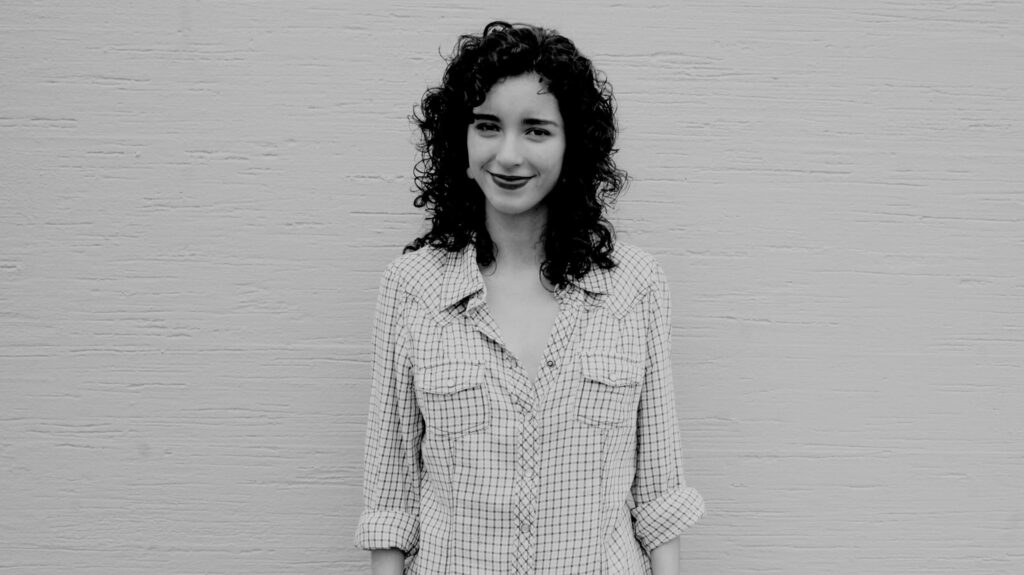
NYFA: Hi Lucy, would you mind telling us a bit about your background and what drew you towards screenwriting? Why did you decide to study screenwriting at NYFA?
LUCY LUNA: I started writing very young. I wrote a lot of short stories, my mom noticed they all had a twist toward the end, she thought I had style, but all moms love what their kids do. So I read them years later and I thought they were awful, but not bad for a seven or ten-year-old kid. Then I started blogging and using social media, tweeting micro stories or poems and I started getting good responses from people.
I knew I wanted to write movies when I was fourteen or fifteen. I spent hours watching The Making-Of from a lot of movies and I found magical the fact that hundreds of people were running around working on a movie that someone wrote. That’s what I wanted. I had a screenwriting class at the degree I was studying, and once that class finished I dropped out, I made a couple of short films and a movie, while taking screenwriting courses everywhere and reading screenwriting books. But that movie never passed the editing room, and those short films were missing something. I knew I needed to learn and improve but I never found a school that satisfied my needs so I started looking outside my country. After a lot of research, I chose NYFA.
NYFA: You are originally from Morelia, Mexico. What opportunities are there in terms of education for aspiring filmmakers in your country? How do you find your nationality impacting your role as a storyteller, if at all?
LL: I think there’s a reason why you see people like Del Toro, Cuarón or Iñárritu working here and not in Mexico. I love my country, but it’s going through a painful situation on so many levels. In terms or art, I can make a huge list of talented people that are stuck because of the system. Our government couldn’t care less about anything, much less about any artistic field. Every president reduces the budget that is supposed to go to art. The only thing they do is tweet proudly whenever someone wins an Oscar.
I know only one good film school that actually has the tools to provide students the education they need. Even though, the admission process is tough. The classes have a small number of students, which I think is great for teaching and learning purposes, but then, the talented people that don’t get in, they don’t have any other options to go to.
I do love Mexican films though. Days of Grace is one of my favorites and I bet nobody’s heard of it. Beyond Cuarón or Iñárritu, we also have a lot of directors winning Cannes or Sundance such as Gerardo Naranjo, Michel Franco, Amat Escalante and Everardo Gout.
Mexico is going through a lot of issues. I feel my only way to help is to write about it. I’m currently developing a script in Spanish inspired by the disappearance of 43 students last year. It was such a hazy situation that it shook our entire nation.
NYFA: What themes, topics, or genres do you find yourself most drawn to? What are some overarching themes that you’ve found tend to pop up across your work?
LL: Most of my stories beg the question “what’s wrong and what’s right? And who establishes that?” my characters are always breaking rules, for good reasons. And I always have female leads. As a writer, I would say I’m most drawn to thrillers and light dramas.
NYFA: What aspect of NYFA’s curriculum did you find the most conducive to helping you to grow and develop as a writer?
LL: I read a lot of reviews and they all mostly agreed in NYFA having a great screenwriting department, I also did some research on the alumni, they are selling pilots, etc. Once the course started the teachers and their classes spoke for themselves. I do think NYFA has a brilliant screenwriting department. All the professors are working writers but more than that, by their feedback and guidance you immediately know their knowledge in this field is huge. I don’t think I can’t measure how much I learned last year.
NYFA: You recently won Best Drama at the Sundance Table Read My Screenplay for your screenplay Sophie & Valentina. What have you learned by submitting and being accepted to festivals and what are some pieces of advice you would give aspiring screenwriters in terms of creating screenplays that will perform well at festivals? Why do you think Sophie & Valentina has been particularly well-received?
LL: I think the journey starts by being honest with yourself. We might all love screenwriting, which is why we move to LA or invest in a school like NYFA, but it doesn’t hurt to ask: “am I ready to get my material out there? Do I have the necessary tools? Do I need more training?” and as harsh as it may sound… “Am I talented enough? Or do I need to work harder than the ones who are?” And no matter what the answers to these questions are, if you really love writing… Don’t quit.
Sophie & Valentina is a story I’m very proud of, I think it’s a beautiful concept, but when I graduated it wasn’t ready, so I sat down with Nicholas Oktaras, we destroyed each other’s scripts and did another rewrite based on that. We’ve both won a Screenwriting Competition each, with the third draft of our scripts. I asked myself, “How did that happen?” I still polish and read my script every time there’s a competition I’m interested in. So I think the answer is… I had a story I was passionate about and I worked hard. I knew the journey wasn’t over after graduating and also; I didn’t take NYFA as a school but as the place where my career would start. I never skipped a class, always handed in pages and never took the advice that most of the teachers gave: “Just vomit, just write, it’s only a first draft” I made sure I was writing the best possible pages according to the tools and time I had back then. Of course it wasn’t perfect, it was a first draft, but it was better than if I just wrote for the sake of writing for class. I did my best because I trusted in my story and I knew I wanted to get it out there. I didn’t treat it as an exercise to pass a course. I never used excuses, and mostly, I enjoyed every word and every page I wrote.
And of course, if somewhere out there Sophie & Valentina’s third draft was well-received is not only because I worked hard but also because I had a brilliant mentor, Matt Harry, and classmates that always had notes to give. I knew exactly what needed work.
NYFA: Since graduating from the One-Year Screenwriting Conservatory, you’ve participated in the Alumni Workshop at NYFA. How has this helped you to develop your skills as a screenwriter and has it helped you to forge any new working relationships?
LL: Once you graduate, the Alumni Class gives the best students the opportunity to write in a workshop with a professor. I love it, all my classmates have a high screenwriting level, we help each other, and the workshop moves fast. It’s not a class, it’s being inside a writers room. This helps because there’s the freedom to work at your own pacing and with your own method.
NYFA: Not being from the USA yourself and studying with a very international student body at NYFA, how did the international nature of NYFA help you to develop as a writer? Did you find yourself exposed to certain world views or approaches to screenwriting that you wouldn’t have encountered otherwise and how did those help shape you as a writer.
LL: I felt very comfortable. I think there were only two Americans in my class. There are people from all around the globe and I love that. If there’s anything I learned is that stories are universal, and it doesn’t matter where you’re coming from. That’s the beauty of being a writer.
NYFA: You began writing horror stories around the time when you were 10. Do you find yourself still drawn to the genre and/or do you feel that female horror writers are able to bring something new to the horror genre? If you are not still interested in horror, what genres have you found yourself particularly drawn to as a screenwriter? What kind of projects do you think are the most fun for you?
LL: I love horror and I still want o write a horror one day. I don’t think it’s a matter of gender, the horror genre has been suffering for a while, there are some terrible movies out there but we’ve had some great ones too. I think it is one of the genres where it’s easier to fall into clichés. So it’s definitely a challenge.
At the moment I don’t have any particular idea for a horror script, but I am developing a couple of thrillers. I find thrillers very exciting to write. But I also enjoy light dramas or what we call ‘dramedies’.
NYFA: Do you have any parting words of advice for aspiring screenwriters and what the best practices are for realizing one’s goals as a screenwriter?
LL: I don’t want to say work hard, study, read scripts, write everyday, etc. I think when someone loves screenwriting; nobody needs to tell them what to do. I think they’ll be guided by their passion, and everything else comes naturally. I also think our love for screenwriting is what gives us strength to find patience; it gives us courage and humility. So I would say, if you love this, be honest, acknowledge your strengths and weaknesses as a writer, work on them, and don’t quit